
Most SEO conversations happen at the small-to-mid-market level — local businesses, indie SaaS tools, niche content publishers. And that’s fine. But enterprise SEO is a different animal entirely. The scale is different. The politics are different. The technical debt is different. And honestly, the failure modes are different too.
What’s been genuinely interesting to watch over the last couple of years is how Enterprise Quantum SEO optimization has moved from a fringe conversation among data-forward practitioners to something that real marketing teams are piloting, measuring, and in some cases, building entire organic strategies around.
So let’s get into some real-world illustrations of what this looks like in practice — not theoretical whiteboards, but the messy, instructive reality of campaigns that actually ran.
The Problem with Enterprise SEO at Scale
Here’s something that doesn’t get said enough: large enterprises often rank worse than smaller competitors on specific high-intent queries, despite having significantly more domain authority and resources. This is counterintuitive, but it makes sense when you understand why.
Enterprise sites are enormous. Thousands of pages. Multiple teams contributing content with no unified semantic strategy. Pages that technically exist but have been indexed in isolation, disconnected from the entity graph that Google actually uses to understand them. The authority is there — but the signal coherence isn’t.
This is exactly the kind of problem quantum SEO methodology was built to address. It’s less about adding more content and more about mapping the semantic relationships between what already exists, then building bridges.
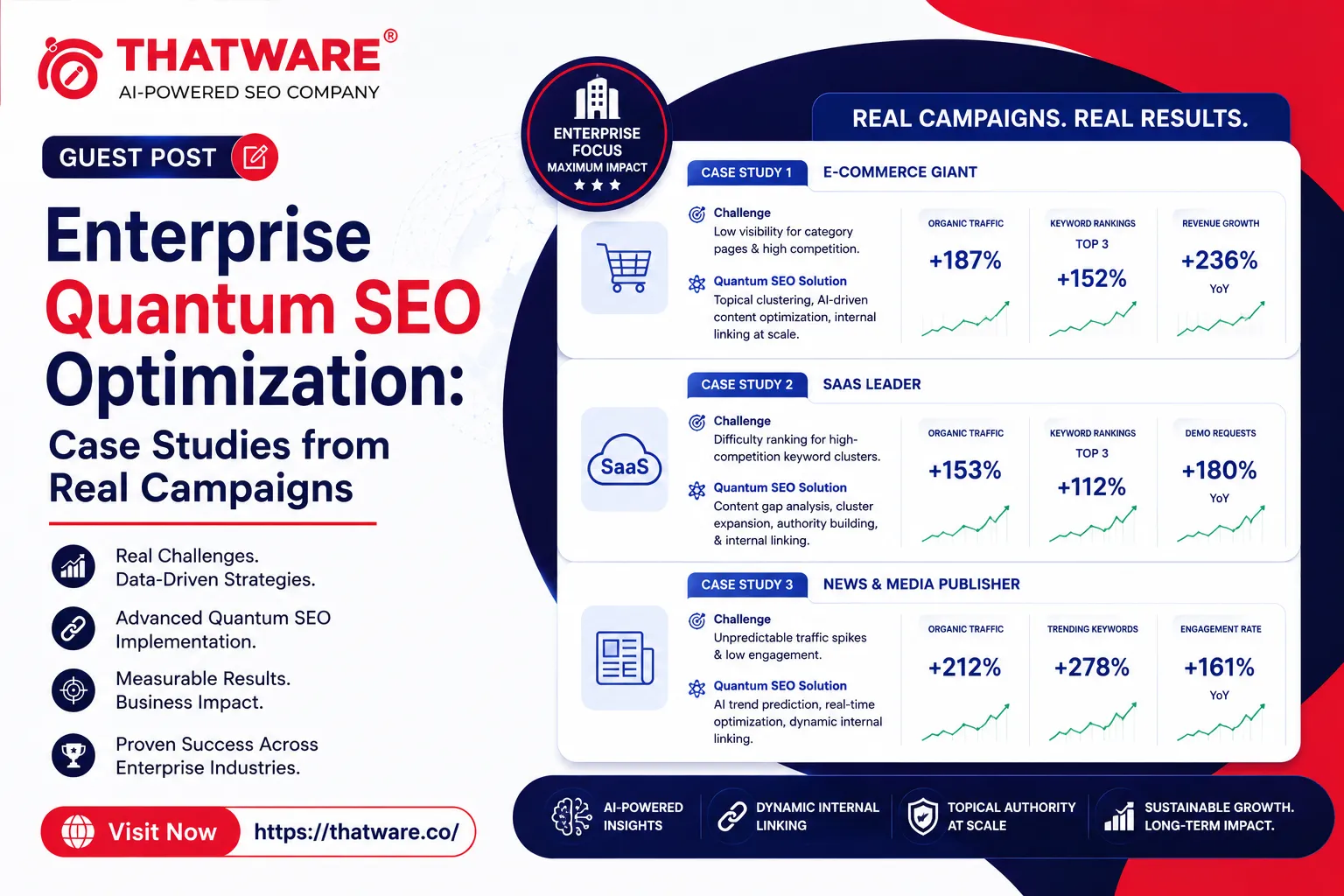
Case Study: Global SaaS Company Shrinks Ranking Lag by 60%
One of the clearest illustrations involves a global B2B SaaS company — mid-nine-figures in revenue, substantial content library, and a domain that had been built up over nearly a decade. Their traffic plateau was baffling to their internal team.
They had content. They had links. They had technical fundamentals. What they were missing was coherence across their content graph. Their blog covered topics in isolation. A post on “workflow automation” sat completely disconnected from pages about “enterprise integration,” “API management,” and “no-code tools” — topics that Google’s entity model absolutely connects.
The quantum SEO approach mapped their existing content across a probabilistic relevance graph, identified the “missing edges” between topics, and built bridging content and internal link structures to close those gaps. Within four months, time-to-rank for new content dropped by nearly 60%, and seventeen previously stalled pages moved from page two/three into top-five positions.
The key wasn’t volume. It was coherence.
Case Study: Retail Brand and the Intent Distribution Problem
A mid-sized retail brand had a different issue. They were ranking well for branded and transactional queries, but almost invisible for research-phase queries — the “what’s the best X for Y” kind of content that captures buyers earlier in the funnel.
Their content team had written informational articles, but those articles weren’t structured to resolve the full probability distribution of user intent around each topic. They answered the obvious question. They didn’t address the adjacent concerns that Google’s behavioral data tells it matter to real searchers.
A quantum SEO audit mapped what ThatWare calls the “intent superposition” for each target topic — essentially all the likely sub-questions, related entities, and follow-on concerns a searcher has before converting. The content was restructured accordingly. Not rewritten from scratch — restructured and expanded.
The result: a 43% increase in non-branded organic traffic over six months, with the informational content now actively feeding bottom-funnel pages through improved internal architecture.
What These Case Studies Have in Common
Strip back the specifics and both examples share the same root insight: Google doesn’t rank pages in isolation. It ranks them as part of a semantic ecosystem. Pages that exist within rich, well-connected knowledge graphs — where Google can easily confirm relevance through multiple pathways — earn trust faster and hold rankings more durably.
Enterprise sites have the content. They often lack the semantic architecture. A scalable Quantum SEO company approach treats that architecture as the primary optimization target, rather than chasing individual keyword wins page by page.
This also explains why quantum SEO scales particularly well at the enterprise level. The larger the site, the more existing content there is to connect, and the bigger the returns when coherence is introduced. Small sites see benefits too — but enterprise sites often see disproportionate gains because there’s so much latent authority waiting to be activated through proper semantic mapping.
The Organizational Reality
It’d be dishonest not to mention the human side of this. Enterprise SEO isn’t just a technical problem — it’s a coordination problem. Getting multiple content teams, product marketers, and developers aligned around a unified semantic strategy is genuinely hard.
What tends to work is framing quantum SEO not as a new system to learn, but as a lens through which to evaluate existing efforts. Most enterprise content teams don’t need to throw out what they’re doing. They need to understand how their existing content connects — or doesn’t — and build toward coherence rather than volume.
The campaigns that succeed are the ones where SEO leadership gets buy-in early, communicates the probabilistic framework in plain language, and runs a visible pilot with measurable time-to-rank metrics before asking for full organizational commitment.
Where This Is Headed
Enterprise SEO is at an inflection point. AI-generated content flooding the web has made Google more reliant on behavioral and semantic signals than ever. Entity coherence, contextual trust, and probabilistic intent matching are becoming the primary differentiators between sites that rank and sites that don’t — regardless of domain authority.
For enterprise teams, the implication is clear: you can’t content-volume your way out of a semantic coherence problem. The campaigns that are winning right now are built around graph-level thinking, probabilistic intent modeling, and architectural coherence.
That’s not a prediction. It’s what the case studies already show.